I’ve promised a discussion of curriculum writing. But before I can deliver it, I have to consider how knowledge works. This is covered by a branch of philosophy called Epistemology. As you’d expect, different epistemologists have different ideas about what knowledge is, what does and does not count as knowledge, and how knowledge is structured. Some would agree more; some would agree less with the following conclusions, which are my own understanding of knowledge.
1. Knowledge arises, initially, from observation. Simple observations can result in distinct and true units of knowledge (“I have brown eyes, and my wife has green eyes”). The derivation of knowledge from simple observations does not require education even to the point of basic literacy. You might argue that it requires language, if you believe forming thoughts is impossible without language. However, animals do not have language, and they do seem to draw true, if simple conclusions from their observations.
2. The great and ever-growing edifice of humanity’s knowledge, to which education (formal and informal) is the access card, is the result of investigation. Investigation means assembling, evaluating, analyzing, and synthesizing evidence in a methodical way, and drawing conclusions from it. It includes the investigative methods of the scientist, the historian, the journalist, and the detective, among others. Because conclusions reached through investigation are falsifiable, they can be affirmed or refuted by subsequent investigation, which may use new evidence and/or re-evaluate and re-analyze older evidence.
3. Knowledge, therefore, is evidence-based, accessible through investigation, and falsifiable. This applies not just to investigation-based knowledge but also to knowledge based on simple observation. The conclusion that my cat is lying on my bed is based on evidence—my observation of my cat on my bed, accessible through investigation—my looking on my bed to see if my cat is there—and falsifiable—somebody else can also look on my bed and decide for themselves whether I am right about the location of my cat.
4. Although knowledge from investigation can be a great deal more complex than knowledge from simple observation, all knowledge begins with observation. When gleaned from investigation, it begins with the observations of the investigators. It depends, therefore on sensory input. This tells us the basic structure of knowledge:
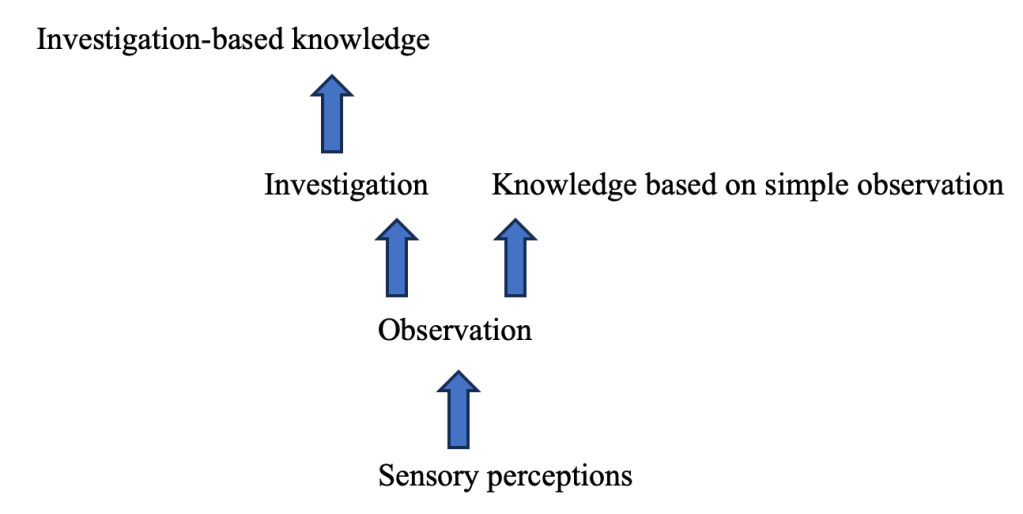
An epistemologist would call this a kind of Foundationalism: the belief that the structure of knowledge works upwards from a foundation that we can take as true.
5. Not all epistemologists are foundationalists. In particular, some question the validity of sense perception as a foundation for the edifice of knowledge. It is true that sense perceptions are not always accurate. Extreme cases include the perceptions of people using hallucinogenic drugs or suffering from psychosis. However, sober and sane people can also make perception errors. We’ve all experienced optical illusions, and we’ve all misheard people. And, of course, people can mis-remember and mis-report their observations. These are all good reasons for investigators to check on the validity of people’s observations, and good investigators, whether detectives, journalists, or experimenters working with human participants, will look for ways to do this.
6. However, we should not give credence to the view that our sense perceptions cannot, as a rule, be trusted, that they are not, when used judiciously, a solid foundation for the edifice of knowledge. Arguments to that effect should not be treated as anything more than an intellectual parlor game. If you doubt your sensory perceptions, and assuming that you have no medical reason for doubting them, try living for one day on the assumption that the information they offer you is false. It won’t go well. In fact, it will very likely kill you. Trusting sense perception produces good results, from the avoidance of fatal accidents to the entirety of human knowledge. Failing to trust it would produce catastrophic results. That proves that sensory experience is to be trusted. This can be disputed, but only by resorting to “well, what ifs” on the level of “what if evil demons are imprisoning our minds and making us hallucinate everything” or “Remember those Matrix movies? What if they’re true?!”
7. Much investigation-based knowledge is formed and verified by “expert communities” such as the medical and scientific communities. Members of expert communities usually have relevant credentials and experience. The knowledge that members form and that the expert community as a whole verifies is accessible to humanity as a whole through reading, through documentaries, podcasts and other forms of media, and through formal education. In some cases, however, understanding the information will require specialist training. Without a thorough scientific education, I can read a little about a health problem on websites for the general public. But if I try to dig deeper, for example by reading peer-reviewed medical literature, I will at some point come up against the limits of my intellectual preparation.
8. Experts can make mistakes. They can miss parts of picture, and in some cases, they can be flat-out wrong. That’s why it’s important to remember the last part of the above definition of knowledge: it is falsifiable, and it stands open to falsification. However, successful challenges by outsiders to expert community are rare. People who believe that the earth is flat, that global warming is a Chinese hoax, or that vaccines are making children autistic are not going to turn out to have been right after all[i].
9. What I’ve just written makes investigation-based knowledge seem like an elite preserve. In many fields, it is. Sometimes, new knowledge can only be formed by people with a lot of intellectual preparation, usually in the form of advanced degrees. Sometimes, new knowledge can only be formed by people with expensive equipment, research staff, and a large grant to pay for these things. However, there are other cases in which knowledge can be formed by people with more limited training and/or experience, such as journalists or amateur natural historians, archeologists, or historians.
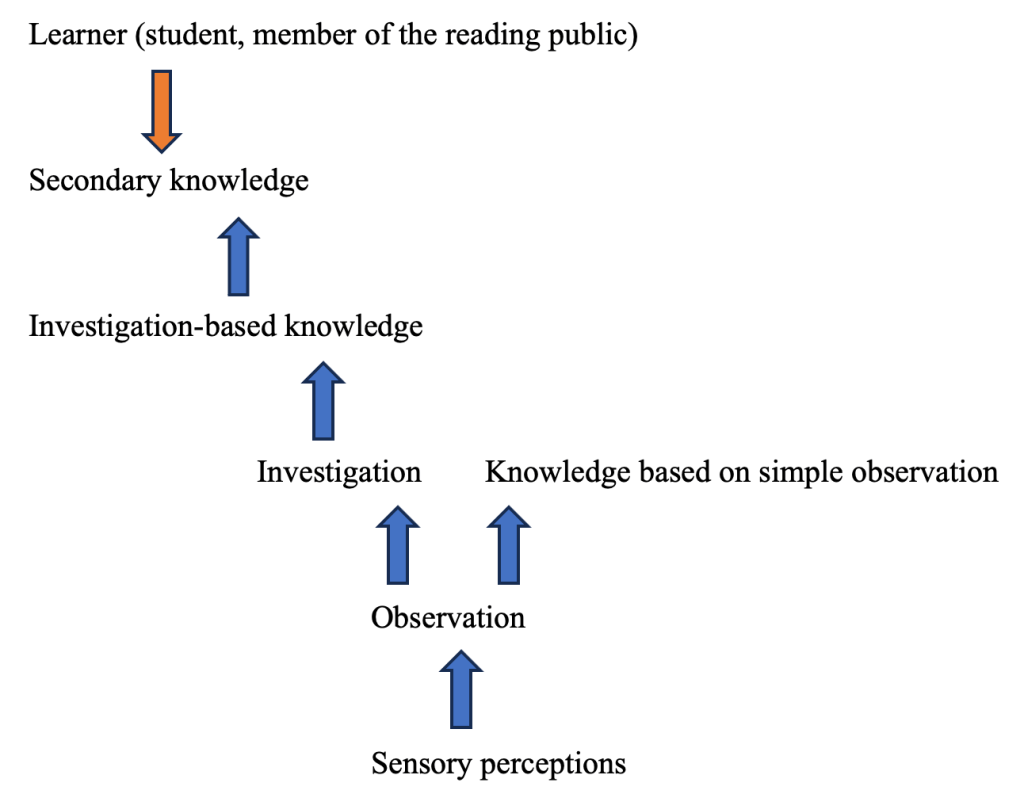
10. Above, I’ve discussed the creation of knowledge through (1) simple observation and (2) through and methodical investigation. I’m going to add a third pathway to knowledge, and I’m going to call it “secondary knowing.” It covers the obtaining knowledge by reading, or watching or listening to the information gleaned through the investigations of others. It’s not really a separate category of knowledge, because it is still knowledge obtained through investigation. However, in terms of the how an individual accesses and experiences knowledge, it is separate. Because no person can make more than a very limited number of discoveries on the basis of their own investigations, and only in a limit field or fields, most of any person’s knowledge is secondary. Indeed, people who make discoveries through investigation would not gain the skills and background knowledge they need to make those discoveries if they could not first gain secondary knowledge.
We can now further develop out diagram of the structure of knowledge. The orange arrow represents not a process of discovery but various processes of study, not the formation but the consumption of knowledge.
11. Secondary knowledge varies in quality. It is necessary to be careful about the sources from which one obtains it. For me, this means only reading non-fiction books that are written by or recommended by legitimate members of the relevant expert community, or that are written by highly successful journalists who know which sources to consult and how to use them. It means reading only the legitimate news media (I read The Economist for national and international news, and a local newspaper for state and local news), and also paying attention to the book reviews in such.
12. Certain methods of obtaining knowledge, though widely used, are not legitimate. One of these is what I will call “rumored facts.” These are things that people believe because they have “heard it.” They usually cannot tell you where they have heard it, but this often does not dampen their certainty that it is true. For example, have you heard the one about the US Army in the Philippines shooting jihadists with bullets smeared in pig’s blood and then burying them covered in pig entrails so that the local population would think that the jihadists had gone to Hell? Apparently, everyone was then too scared to be a jihadist. There’s no evidence that this actually happened, and, in my experience, Muslims are a lot more theologically sophisticated that the yarn implies. But Muslim-haters still circulated it by email after 9/11. Or the one about the Christian kid at some elite university, sometimes Harvard, who avoided failure, or sometimes expulsion, by winning a debate against an atheist professor? Again, no evidence. And no university has a grading procedure or a disciplinary procedure like that. But this rumored fact still became the basis of a movie that many people think of as a true story: God’s Not Dead (2014).
13. As you can see, the hallmark of rumored facts is that they cannot be verified. There is no evidence. Any investigation will come up short. Therefore, on the basis of the definition that I suggested earlier, that knowledge is “evidence-based, accessible through investigation, and falsifiable,” rumored facts are not a form of knowledge. They may be falsifiable, but they are not grounded in evidence or investigation.
14. Another widely used but illegitimate form of knowledge is received wisdom, possibly the greatest foundation by bigotry. Received wisdom tells people that women are less rational than men, that black people and Muslims are violent, that Jews are greedy and self-serving, that gay people are closet pedophiles, and that immigrants are disease-carrying criminals. These notions are falsifiable for sure, and thoroughly falsified. They are not grounded in evidence or investigation. Received wisdom, by definition, never is, and it is therefore not a legitimate source of knowledge.
15. Finally, what is sometimes called “heart knowledge,” knowledge gained from something that might be termed instinct, or from religious experience[ii] is not a legitimate form of knowledge, because it is not falsifiable, at least not in its own terms. However, this does not mean that its conclusions are necessarily wrong. The Stanford Encyclopedia of Philosophy makes a convincing argument in defense of knowledge that seems to have a basis in instinct rather than accepted forms of rationality:
“… harms and wrongs might even be built into our practice of epistemic appraisal…Suppose, for instance, that it is constitutive of our practice of epistemic appraisal to count someone as knowing a fact only if they possess concepts adequate to conceptualize that fact. Whatever may be said in favor of our practice’s having such a feature, one of its effects is clear: those individuals who are cognitively most sensitive to facts for which adequate conceptual resources have not yet been devised (e.g., someone living long before Freud who is sensitive to facts about repression, or someone living in the nineteenth century who is sensitive to facts about sexual harassment) will find that the deliverances of their unique cognitive sensitivities are not counted as knowledge.” [iii]
***
The above represents my conclusions on the nature of knowledge: what it is, what it is not, how we come by it, how it forms an edifice, and how it is structured. I don’t get the final word on these matters. Nobody does. But I believe that my conclusions part of are a sound basis for curriculum planning.
However, for curriculum planning purposes, it is also necessary to distinguish between facts and opinions. The distinction is not as easy as some people think. Consider the following statements.
A: The earth is round.
B: The earth is flat.
C: Shellfish are delicious.
D: There is life on other planets.
E: All species are products of evolution.
F: God exists.
G: Law enforcement officers should be allowed to tap phones without warrants.
H: An anatomical female who identifies as male is a man.
J: I am qualified to teach AP Government.
K: My doctor is an expert in psychiatry.
L: The witness’s testimony proves that the accused person is innocent.
M: In the next Olympic Games, the USA will win more medals than any other country.
Obviously, A is a fact and B is a falsehood. Both are in the domain of knowledge, as they are falsifiable through evidence-based investigation. Such investigation will falsify B and affirm A. C, however, cannot be falsified. It is not subject to investigation. It is not a matter of knowledge but of taste—a separate domain to knowledge.
So far, we are not in the domain of opinion, or anywhere near it.
The next three are more complicated. All could be (or, in the case of E, could at one time have been) considered matters of opinion, but not in exactly the same way. We do not know whether there is life on other planets. Some experts consider it more likely, others less likely. However, there is a correct answer that we may one day know. Therefore, D is a matter of opinion in a provisional sense. E was once a matter of opinion in the same provisional sense. In Darwin’s time, some eminent scientists thought that he was wrong. The scientific community has now resolved the question in favor of evolution. Therefore, E has moved from the status of D to the status of A.
F is similar to D in that there is a right answer. When a religious believer says that God exists and an atheist says that he does not, one of them must be wrong (or both could be wrong, if, for example, there is really a pantheon of gods). Both the believer and the atheist may advance reasoned arguments, with evidence, to falsify the other’s belief. However, the matter may be beyond resolution, not least because there is no common agreement on what constitutes proof. Does the truth of evolution prove that God does not exist? Well, no. It merely proves that God either did not create species or did not do so in the way that some believers think he did. Would God’s ripping open the sky and showing himself to world prove that he exists? No, not to universal satisfaction. Doubters would argue that the spectacle had been pulled off by a bad actor, perhaps another kind of supernatural entity, who wanted us to believe that it was God.
We are in the domain of opinion now, but only because we don’t have enough information to be in the realm of irrefutable fact.
The remaining six, G, H, J, K, L, and M are truly statements of opinion. In debating the issue, facts may be used by any side, perhaps convincingly. But the issue will always boil down questions that cannot be fully resolved by examining evidence, or by more evidence showing up. G boils down to what a person finds subjectively more important—the potential benefits of law enforcement officers tapping phones without warrants, or the potential losses. Should we give up X measure of our privacy to gain Y benefit in public safety? One cannot falsify any answer to that because it is, in a way, a matter of taste.
C was not in the realm of opinion, because it pertain purely to a matter of taste, not to something in any way debatable. G is debatable, but taste will have a bearing on people’s opinions.
H hinges on categories. In thinking about the issues raised by transgenderism, some people focus on biological sex, divide humanity into biological male and female, and see intermediate cases like intersex people (sometimes known as hermaphrodites, though I understand that this is not their preferred term) as exceptions rather than parts of the rule. Those people reject H, inevitably. Others, often focussing on gender as a social phenomenon rather than just on biologica sex, have more complicated ideas about sex/gender categories. They are more likely to affirm H. Again, arguments and evidence only go so far, because what really drives the debate is the categories that people chose to deal in.
J and K come down to categorization of a different kind. What is a qualified person? Do I have to have a political science degree to be a qualified person where the teaching of AP Government is concerned? Given that it is a college level class, do I need a graduate degree? Or is a degree in history or a related field sufficient? How important is state licensure? How important is my reading and/or experience outside of my formal education?
And what is an expert, as opposed to a qualified practitioner? In K, my doctor certainly knows more about psychiatry than the average person, but does that mean that my primary care doctor is an expert in psychiatry? What if I’m not talking about by primary care doctor but my psychiatrist? It would be hard to argue that she is not a qualified practitioner, but is that the same thing as an expert? Should she have a certain amount of experience, have published in a peer reviewed context, or have taught psychiatry in medical school before she can be considered an expert?
L depends on the evaluation of evidence and its source. Should I trust the witnesses honesty? What about her sanity? What about the strength and completeness of her perceptions of what she bears witness to?
Moreover, what evidence, who’s evidence, and what kinds of evidence can be considered reliable, and how far can they be trusted? If I’m looking at a statistic that supposedly demonstrates a sociological trend, how was the data compiled? Is it truly representative? Does it yield the conclusion I’m being told that it yields? What about the personal testimonies that point to the same trend, or the expert testimonies concerning it? Am I to trust the people giving the personal testimonies? Am I to consider them representative? Are the experts really experts? Are they testifying in good faith, even though they may have opinions, or are they driven by ideology more than by evidence?
L, then, along with J and K, helps illustrate why matters of opinion can be so hard to resolve. Evidence is helpful, but only so far. We are not guaranteed agreement on what constitutes credible evidence or on what constitutes a credible source of evidence.
M is a case of what could be called “predictive opinion”? Come the closing ceremony of the next Olympic Games, will will be able to say that M was right or wrong. At the present, however, we can argue the point on the basis of factors like what happened in the past, which athletes are likely to represent which countries, what their records say about their possible future performance. Whether we agree with M is likely to depend on how much weight we give to each piece of evidence.
G through M, then, represent where the realms of knowledge and opinion truly diverge—where falsification is impossible, or when there is no common agreement on what constitutes falsification because there is no common agreement about underlying categories (H), about what constitutes legitimate evidence, or, in other words, what kinds of information can be used for falsification (L), about whom we should listen (J and K), or about which evidence should be given greater weight (M). This is the true domain of opinion. It exists in dynamic relationship with knowledge, making simplistic distinctions between fact and opinion difficult. It is a myriad of mazes that cannot be walked in without knowledge, except by those who love to stomp around a maze and bloviate. But it is not the same thing as knowledge.
[i] For an excellent discussion of the value of expert knowledge, and of the growing tendency to deny it the respect that it deserves, see Tom Nichols, The Death of Expertise: The Campaign against Established Knowledge and Why it Matters. 2017. Oxford University Press.
[ii] William James’s seminal The Varieties of Religious Experience (1902) is well worth the reading, especially for his thoughtful discussion of religious experience as an approach to truth.
[iii] “Epistemology,” from the Stanford Encyclopedia of Philosophy. 14 December 2005. Substantive revision 11 April 2020. https://plato.stanford.edu/entries/epistemology/.

 Ignition for Education
Leave a reply to The Nature and Acquisition of Skills – Ignition for Education Cancel reply